May 2, 2026 • Yuki Brennan • 9 min reading time • Prices verified June 18, 2026
BreathableBaby Mesh Liners: Which Panel Count Fits Your Crib?
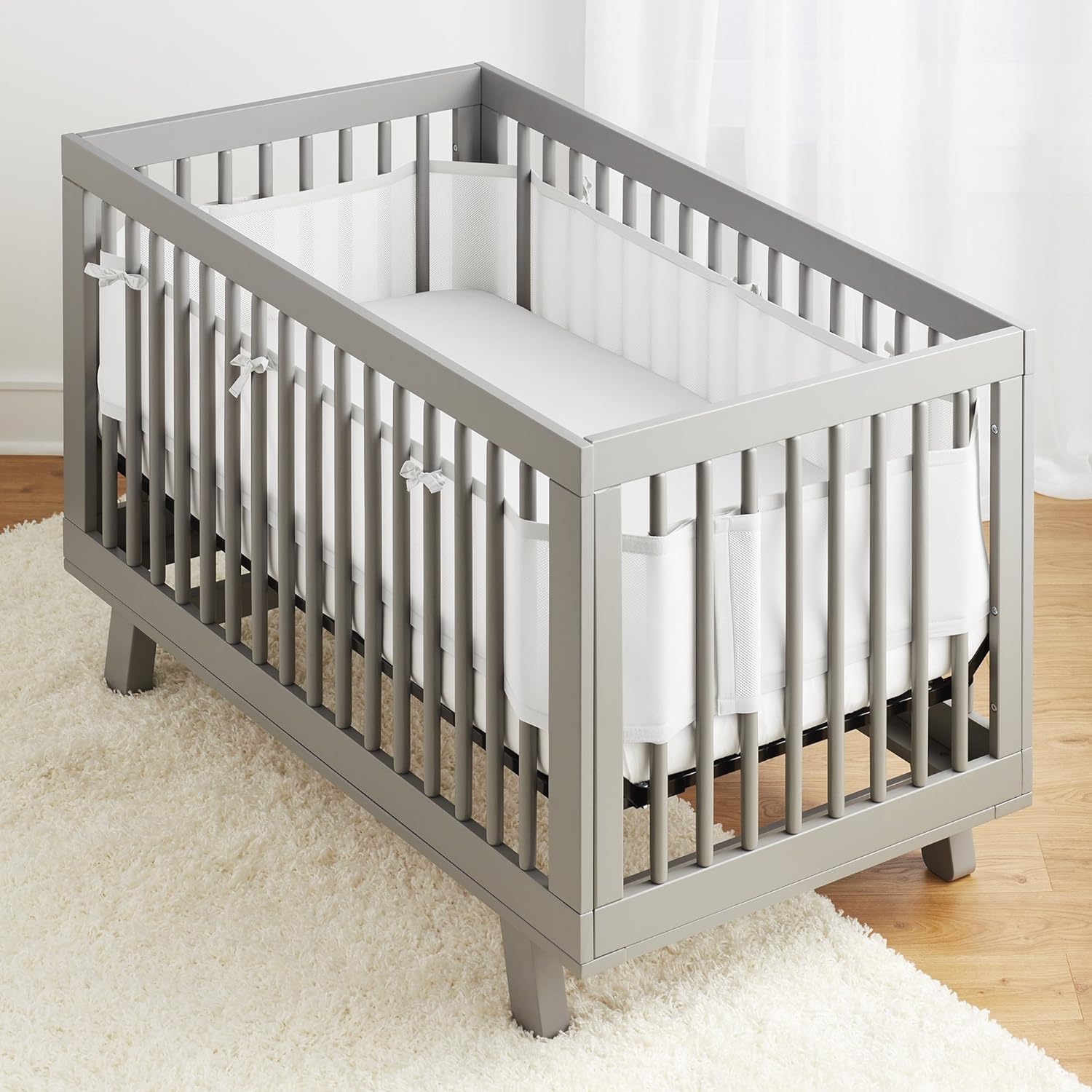
If you’ve landed here because your baby has started gnawing the crib rail — or because you’re setting up the nursery and want to protect the wood before that phase even begins — you’re in the right place. A mesh crib liner is a breathable fabric panel that attaches to the inside of a crib’s four rails (the long sides and short ends), creating a soft barrier between the baby and bare wood. Unlike traditional padded bumpers, which pediatric safety groups have flagged as a suffocation risk, mesh liners are thin, air-permeable, and designed so a baby’s face pressed against them won’t restrict airflow. BreathableBaby is the brand most parents encounter first in this category, and for good reason — they’ve been manufacturing mesh liners since the early 2000s and their products carry safety credentials that hold up to scrutiny. The one thing that trips people up: BreathableBaby sells liners in different panel counts (the number of fabric sections that wrap around the crib), and choosing the wrong count for your crib model means gaps, bunching, or a liner that simply won’t stay put.
This guide will walk you through how to identify which panel count your crib needs, what the fit actually looks like in practice, and where the edge cases are — the convertible cribs, the mini cribs, the non-standard slat spacings — so you can make a confident call before anything ships.
| EDITOR'S PICKBreathableBaby Breathable Mesh… | Mid-tierBreathableBaby Breathable Mesh… | Budget pickBreathableBaby Breathable Mesh… | |
|---|---|---|---|
| Product type | Liner (4 sides max) | Liner (4 sides max) | RailGuard (1 panel) |
| Coverage | 3 or 4 sides | 3 or 4 sides | 1 side |
| Panel count | — | — | 1 panel |
| Crib size | Full-size | Full-size | Most full-size |
| Length | — | — | 51 in |
| Color | Gray | White | White |
| Price | $44.95 | $44.95 | $24.95 |
| See on Amazon → | See on Amazon → | See on Amazon → |
Why Panel Count Matters More Than You’d Think
Here’s the thing most product listings don’t explain clearly: a mesh liner isn’t one continuous tube of fabric. It’s constructed in discrete panels — individual sections of mesh, each sized to span a portion of the crib’s interior perimeter, joined at seams and tied to the crib’s vertical rails (the slats) with fabric ties. The number of panels determines how the liner divides itself around the four sides of the crib.
A standard full-size crib (the most common format in the U.S., regulated under CPSC — that’s the Consumer Product Safety Commission — to a mattress footprint of roughly 28 × 52 inches) has a specific interior perimeter. BreathableBaby’s flagship liner, the Classic Breathable Mesh Crib Liner, is built in a 4-panel configuration: two long panels for the crib’s long sides, and two short panels for the head and foot ends. Each panel ties independently to the slats. This works cleanly for most standard cribs because the seams land at the crib’s corners, which is exactly where you want them — the corner posts provide a natural anchor point and the panels don’t need to stretch across a joint.
The problem arises with:
- Cribs that have more than four sides (some convertibles and round cribs)
- Mini cribs and travel cribs, which have a smaller perimeter and require a different panel sizing
- Non-standard cribs — IKEA models, vintage/heirloom pieces, or European imports — where the interior dimensions don’t match the CPSC standard
Getting this wrong doesn’t just mean a sloppy aesthetic. A panel that’s too short will leave a gap at a seam, creating exactly the kind of opening a determined chewer can find. A panel that’s too long will bunch and create fabric folds — which, in a sleep environment, you want to avoid entirely.
The BreathableBaby Lineup: Panel Counts at a Glance
BreathableBaby’s current product range (as of mid-2026) covers three primary scenarios. Here’s a quick orientation:
By the numbers:
| Liner SKU | Panel Count | Designed For | Interior Perimeter Fit |
|---|---|---|---|
| Classic Mesh Crib Liner | 4 panels | Standard full-size cribs | ~28 × 52 in. mattress footprint |
| Mini Breathable Liner | 4 panels (shorter) | Mini cribs / travel cribs | ~24 × 38 in. mattress footprint |
| Breathable Bumper (wrap style) | Continuous / 1 piece | Standard full-size cribs | ~28 × 52 in. mattress footprint |
The 4-panel Classic is what most parents need. According to BreathableBaby’s published fit guide, it’s compatible with the vast majority of CPSC-standard cribs sold in the U.S. market, including popular models from IKEA (the SUNDVIK and SNIGLAR lines), DaVinci, Babyletto, Pottery Barn Kids, and Restoration Hardware Baby. BabyGearLab’s crib liner review for 2025 notes that the Classic liner “fits cleanly on the cribs we cross-referenced, with ties landing consistently at or near corner posts” — exactly the fit geometry you want.
The Mini liner is sized for cribs with a smaller footprint. If you’re working with a IKEA SNIGLAR (which uses a slightly smaller mattress), a DaVinci Alpha mini crib, or a Guava Lotus travel crib, this is your version. Using the standard 4-panel Classic on a mini crib results in visible bunching along the long sides — owners across aggregated reviews consistently flag this as the main fitting complaint when someone grabs the wrong size.
The Breathable Bumper wrap is a single continuous panel rather than four discrete sections. It offers a slightly different installation experience — no corner seams to manage — and some parents find it faster to reinstall after laundry. The tradeoff is that the wrap relies more heavily on its tie points being evenly tensioned; if you rush the install, the mesh can sag at the midpoint of the long sides.
How to Confirm Your Crib’s Compatibility Before You Buy
You don’t need a tape measure if you know your crib’s model number. Here’s the decision sequence:
Step 1: Confirm your crib is CPSC-compliant and standard full-size. If your crib was purchased new in the U.S. after June 2011 (when the CPSC’s updated crib standards took effect under 16 CFR Parts 1219 and 1220), it almost certainly uses a standard 52 × 28 inch mattress. The CPSC’s crib safety page lists compliant models and the enforcement date if you want to verify. If your crib is older, a hand-me-down, or imported, measure the interior mattress platform — length and width — before assuming standard sizing.
Step 2: Count your crib’s sides. Most cribs are rectangular with four sides. Some premium or boutique cribs (particularly round cribs or hexagonal models) have more. BreathableBaby does not make a panel configuration for non-rectangular cribs — the 4-panel design assumes four right-angle corners. For non-rectangular cribs, you’re in custom-liner territory, and brands like Loulou Lollipop (known for silicone rail guards) or a seamstress offering custom crib bumpers may be the better path.
Step 3: Check your slat spacing. The liner attaches via fabric ties that thread between the crib’s vertical slats — the thin wooden bars running from the crib rail down to the base. CPSC standards cap slat spacing at 2⅜ inches (about 6 cm) to prevent entrapment. BreathableBaby’s ties are sized for this range. If you have a vintage crib with wider slat spacing, the ties may not anchor correctly — and frankly, a crib with non-compliant slat spacing shouldn’t be in use regardless of liner choice. The American Academy of Pediatrics’ Safe Sleep guidance on healthychildren.org is unambiguous on this point: only use cribs that meet current CPSC standards.
Step 4: Identify mini-crib owners early. If your crib came with a mattress smaller than the standard 52 × 28 inches, you need the Mini liner. Common mini-crib mattress sizes are approximately 38 × 24 inches — noticeably smaller. The What to Expect editorial team’s bumper safety overview notes that fit errors are most common among mini-crib owners who default to standard sizing because the product photography doesn’t make the scale difference obvious.
The Edge Cases Worth Naming
IKEA cribs: The IKEA SNIGLAR uses a slightly smaller interior than a true U.S. standard crib. BreathableBaby’s published fit guide lists it as compatible with the Classic liner with minor adjustment — owners report the fit is workable but the long-side panels have a small amount of slack. The IKEA SUNDVIK, by contrast, is a closer match to standard dimensions. If you’re on SNIGLAR, read recent owner reviews specifically for fit notes before ordering.
Convertible cribs with removable side rails: Some convertible cribs (those designed to transition from crib to toddler bed to full bed) have a drop-side or removable panel on one long side. When the crib is in full-crib configuration, the Classic liner fits normally. But if you ever operate the crib in a partial configuration, you’ll need to remove and re-tie the corresponding panel. This is a minor inconvenience, not a dealbreaker — but worth knowing before installation day.
Slat-free or slatted-back cribs: A small number of cribs use solid wood or MDF (medium-density fiberboard) backs rather than individual slats. If your crib has no gaps between the back rail and the mattress platform, the liner ties have nothing to thread through on that side. Some owners improvise by looping ties around the top rail — this works structurally but isn’t the intended installation and may affect tension. For solid-back cribs, a rail cover (a sleeve that slides directly over the top rail) is often the cleaner solution.
If X, Then Y: The Decision Rules
- If your crib is a CPSC-compliant standard full-size rectangular crib purchased new after 2011 → the Classic 4-panel liner fits.
- If your crib uses a mattress smaller than 52 × 28 inches (any mini crib, travel crib, or IKEA SNIGLAR) → get the Mini liner.
- If your crib is non-rectangular, round, or hexagonal → BreathableBaby doesn’t have a fit; look at custom options or silicone rail guards for the top rail only.
- If your crib is a hand-me-down or pre-2011 model → verify slat spacing and CPSC compliance before purchasing any liner.
- If you want the fastest post-laundry reinstall and don’t mind managing even tie tension → the wrap-style Breathable Bumper is worth considering over the 4-panel.
- If you’re buying as a gift and don’t know the recipient’s crib model → the Classic 4-panel is the statistically safe default for U.S. nurseries, but include the receipt.
The mesh liner market isn’t complicated once you understand what “panel count” is actually describing. Match the liner’s designed perimeter to your crib’s actual interior perimeter, confirm your slat configuration, and you’re set. BreathableBaby’s Classic has earned its reputation as the default recommendation for good reason — the fit works for most families, the mesh construction holds up to repeated washing based on aggregated owner reports, and the safety credentials (it meets ASTM F1917, the standard for soft infant products) are documented, not just marketing language. Get the size right, and it’s a straightforward purchase.