May 9, 2026 • Yuki Brennan • 9 min reading time • Prices verified June 18, 2026
Food-Grade Silicone Crib Rail Guards: What CPC and LFGB Certification Actually Means
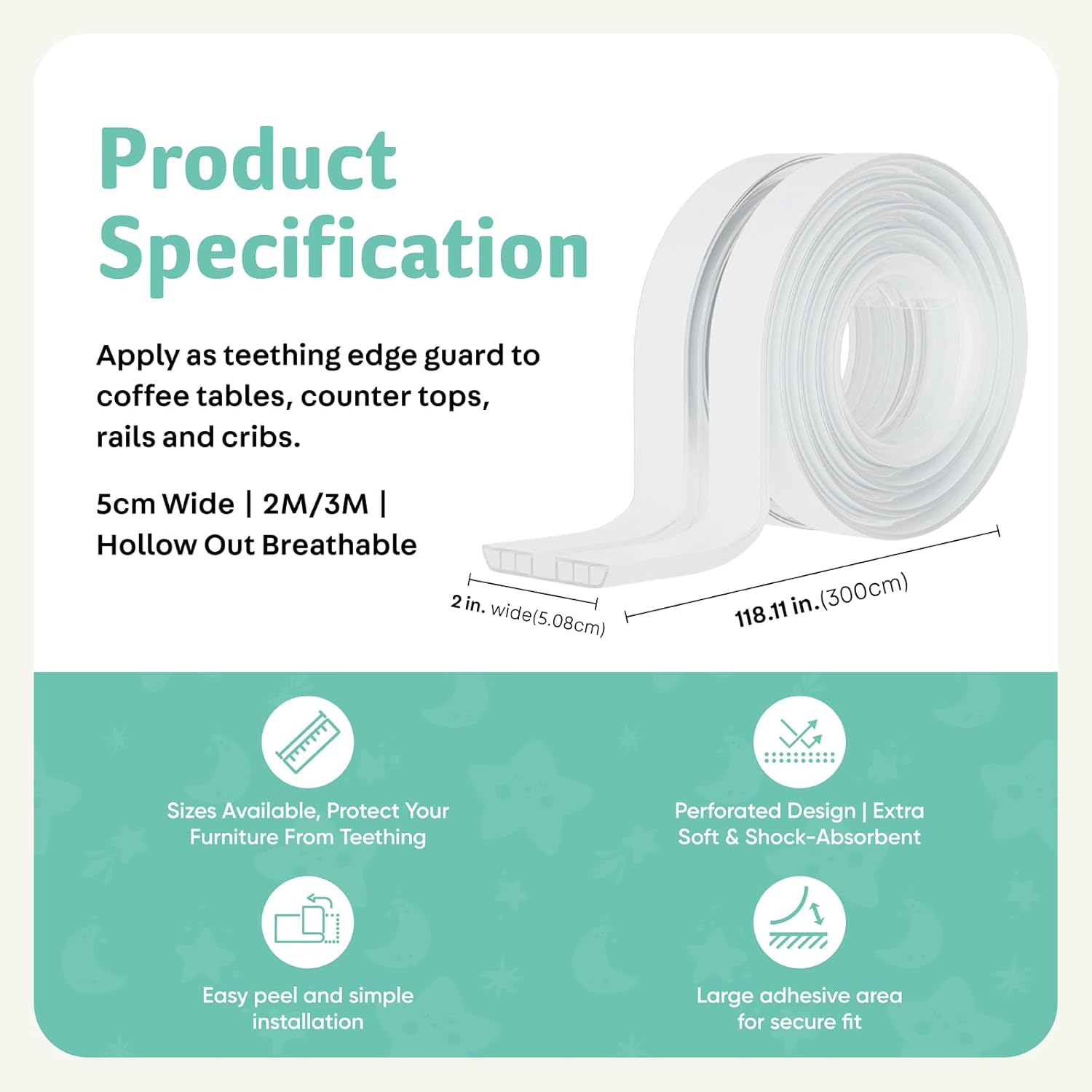
When a baby starts pulling to stand, the crib rail becomes a chew toy — full stop. It’s one of those developmental milestones nobody really warns you about until you walk in and find fresh tooth marks on the wood finish. Crib rail guards are the product category designed to solve this: they’re slip-on covers, usually made of silicone or fabric, that protect the rail (and your baby’s mouth) from direct wood contact. If you’ve started comparing options, you’ve probably run into the phrase “food-grade silicone” alongside certification labels like CPC or LFGB. Those labels matter — they’re not just marketing language — but they also don’t all mean the same thing. This guide breaks down what each certification actually requires, where the gaps are, and how to use that information to make a confident purchasing decision without over-engineering it.
What “Food-Grade Silicone” Actually Means (And Why It’s Not a Certification)
Let’s clear up the most common misconception first: “food-grade silicone” is a material description, not a certification. It means the silicone formulation is composed of silicon, oxygen, carbon, and hydrogen in a ratio and purity level considered safe for food contact — no plasticizers (the chemical additives used to make cheaper plastics more flexible), no BPA (bisphenol A, an industrial chemical linked to hormonal disruption), and no heavy metals like lead or cadmium. When a brand describes their guard as food-grade, they’re telling you about the raw material composition. That’s a meaningful starting point, but it’s not independently verified until a third-party lab tests it and issues a certificate.
Silicone as a material has a well-established safety track record in food applications. The European Food Safety Authority, in its assessment of food-contact silicone materials, has concluded that properly formulated silicone poses no significant migration risk — meaning the material doesn’t leach harmful compounds into what it contacts at normal use temperatures. For a chewing infant, this translates to: a properly formulated, tested silicone guard is unlikely to transfer harmful substances through normal gnawing. The “properly formulated and tested” part is where certifications come in.
CPC Certification: The U.S. Baseline You Can’t Skip
CPC stands for Children’s Product Certificate. Under the Consumer Product Safety Improvement Act (CPSIA), any product sold in the United States that is intended for children under 12 must carry a CPC. The U.S. Consumer Product Safety Commission (CPSC) describes the CPC as a written document — issued by the manufacturer or importer — certifying that the product has been tested by a CPSC-accepted third-party laboratory and meets all applicable federal safety standards.
For a silicone crib rail guard, the relevant standards under a CPC typically include:
- ASTM F963 (the standard consumer safety specification for toy safety, which governs mechanical hazards and certain chemical limits)
- 16 CFR Part 1303 (lead paint ban)
- CPSIA Section 101 (total lead content limits and phthalate restrictions for products that go in children’s mouths)
What a CPC guarantees: The product was tested at an approved lab against specific chemical and mechanical thresholds. Lead content is below 100 parts per million (ppm) in the substrate. Phthalates — a class of plasticizers commonly used in PVC and some rubber products, associated with endocrine disruption — are restricted to no more than 0.1% for products that can be placed in a child’s mouth.
What a CPC does not guarantee: It doesn’t test for every possible chemical of concern. It doesn’t verify the silicone formulation against food-contact migration standards. And critically, the CPC is a self-issued document — the manufacturer writes it based on lab results, but no government agency independently audits every product. The integrity of a CPC depends entirely on the lab doing the actual testing being accredited and the manufacturer reporting honestly.
For a first-time parent, the practical takeaway is this: a CPC is your legal minimum in the U.S. If a product doesn’t have one, it shouldn’t be on your shortlist regardless of price or aesthetics.
LFGB: The German Food-Contact Standard That Goes Further
LFGB stands for Lebensmittel- und Futtermittelgesetzbuch — Germany’s Food and Feed Code — and the silicone testing protocol derived from it (specifically BfR Recommendation XXI for silicone articles) is meaningfully more rigorous than what a CPC requires for chemical migration.
Where CPC testing is concerned primarily with restricted substance thresholds (is lead below X ppm?), LFGB-based silicone testing uses migration simulation: the silicone is exposed to food-simulating solvents under controlled temperature and time conditions, and labs measure what, if anything, transfers out of the material. Passing LFGB migration testing means the silicone doesn’t leach detectable harmful compounds under conditions that approximate real-world contact with food — or, in the nursery context, real-world infant chewing.
This is why you’ll see premium silicone teething and feeding brands prominently advertise LFGB compliance alongside CPC certification. Loulou Lollipop, whose silicone teething and rail guard products sit in the $80–$150 range, publishes safety documentation noting LFGB compliance — a signal that their formulation has cleared migration testing, not just restricted-substance limits. BabyGearLab’s review methodology notes for silicone infant products similarly flag LFGB testing as a differentiating quality indicator among the products they evaluate.
By the numbers:
- CPC phthalate limit (mouth contact items): ≤ 0.1% (1,000 ppm) per CPSIA Section 108
- CPC lead content limit: ≤ 100 ppm total substrate
- LFGB migration test: measures actual substance transfer in simulated food-contact conditions — a pass/fail against migration thresholds, not just static content limits
- OEKO-TEX STANDARD 100 (relevant for fabric hybrid rail covers): tests for 100+ substances including allergens, pesticides, and heavy metals, independently certified
How to Read Certification Claims When You’re Shopping
Here’s where the decision frame gets practical. You’re looking at product listings and you see variations of these claims:
“Made from food-grade silicone” — Material claim only. No independent verification implied. Baseline acceptable, but ask what testing backs it up.
“CPC certified” — Legally required for U.S. sale to children. Confirms restricted substance compliance via accredited lab. Should be your floor, not your ceiling.
“LFGB tested / LFGB compliant” — Migration-tested. Higher bar for silicone safety. Look for this on any product that will see heavy chewing contact. If the brand doesn’t publish the test report or the certifying lab name, treat the claim with some skepticism — LFGB testing costs money, and legitimate results are documentable.
“OEKO-TEX STANDARD 100” — Relevant primarily for fabric components (woven rail covers, hybrid covers with a fabric sleeve over silicone). OEKO-TEX, administered by the OEKO-TEX Association, certifies textiles against a list of 100+ restricted substances. As the OEKO-TEX Association’s published criteria make clear, products certified at Product Class I are specifically tested for infant and baby use. If you’re buying a fabric-silicone hybrid cover, OEKO-TEX on the fabric component plus LFGB on the silicone is the combination worth looking for.
What to actually do: Before purchasing any silicone rail guard above about $40, go to the brand’s website and look for a safety or certifications page. A credible brand will name the testing laboratory and ideally publish the certificate number or test report. If that documentation doesn’t exist or can’t be found after a reasonable search, that’s a signal worth weighing — especially at the $80–$150 price point where you’re paying partly for verified safety.
The Real-World Variables Certifications Don’t Cover
Certifications test the product as manufactured. They don’t govern what happens after months of aggressive chewing, repeated dishwasher or boiling-water sterilization, or UV exposure on a south-facing nursery window. Owners of premium silicone rail guards consistently report that silicone holding up to chewing without tearing or pilling is a function of silicone density and formulation — which varies between brands — not just certification status.
The American Academy of Pediatrics, per Healthy Children’s teething guidance, recommends avoiding any teething product that shows signs of deterioration (tears, discoloration, sticky surface texture). The same principle applies to rail guards: a certified product that has degraded past normal wear should be replaced. The certification tells you the product was safe when it left the factory; your ongoing visual check tells you whether it’s still safe in your crib.
This is also why chew-intensity matters as a shopping variable. A baby who gnaws persistently and forcefully will stress a guard differently than one who mouthed the rail twice and moved on. If you’re in the aggressive-chewer category, prioritize thicker-wall silicone guards (owners of higher-density products consistently report longer useful life) and build a replacement timeline into your cost-per-month thinking. A $120 guard that lasts 18 months of heavy use is a different value proposition than a $45 guard replaced every 4–5 months.
The Decision Rule
If you’re deciding between silicone rail guard options right now, here’s the simplified framework:
If the product is U.S.-sold and lacks a CPC: Remove it from consideration immediately. No exceptions.
If the product has CPC only: Acceptable for light-contact or aesthetic-protection use. For a baby who is actively, regularly chewing the rail, push up to LFGB-tested options.
If the product has CPC plus LFGB migration testing from a named lab: This is the specification worth paying for in the $80–$150 range. You’re not paying for marketing; you’re paying for the migration-test result that the CPC doesn’t require.
If the product includes fabric components: Add OEKO-TEX STANDARD 100 (Product Class I) to your fabric-component checklist alongside the silicone certifications.
If the brand can’t or won’t document its certifications: At any price point, that’s a reason to choose a brand that can — the documentation is not burdensome to provide, and its absence tells you something about how seriously safety claims are being treated.
The certification labels on a silicone crib rail guard are not interchangeable marketing badges. CPC is your legal baseline. LFGB migration testing is the meaningful upgrade for a product that will spend months in contact with a chewing infant. Knowing the difference means you can match the right product to your actual use case — and spend the premium where it genuinely earns its keep.