May 18, 2026 • Yuki Brennan • 9 min reading time • Prices verified June 18, 2026
GOTS and OEKO-TEX Crib Mattress Protectors: Certifications Decoded for First-Time Buyers
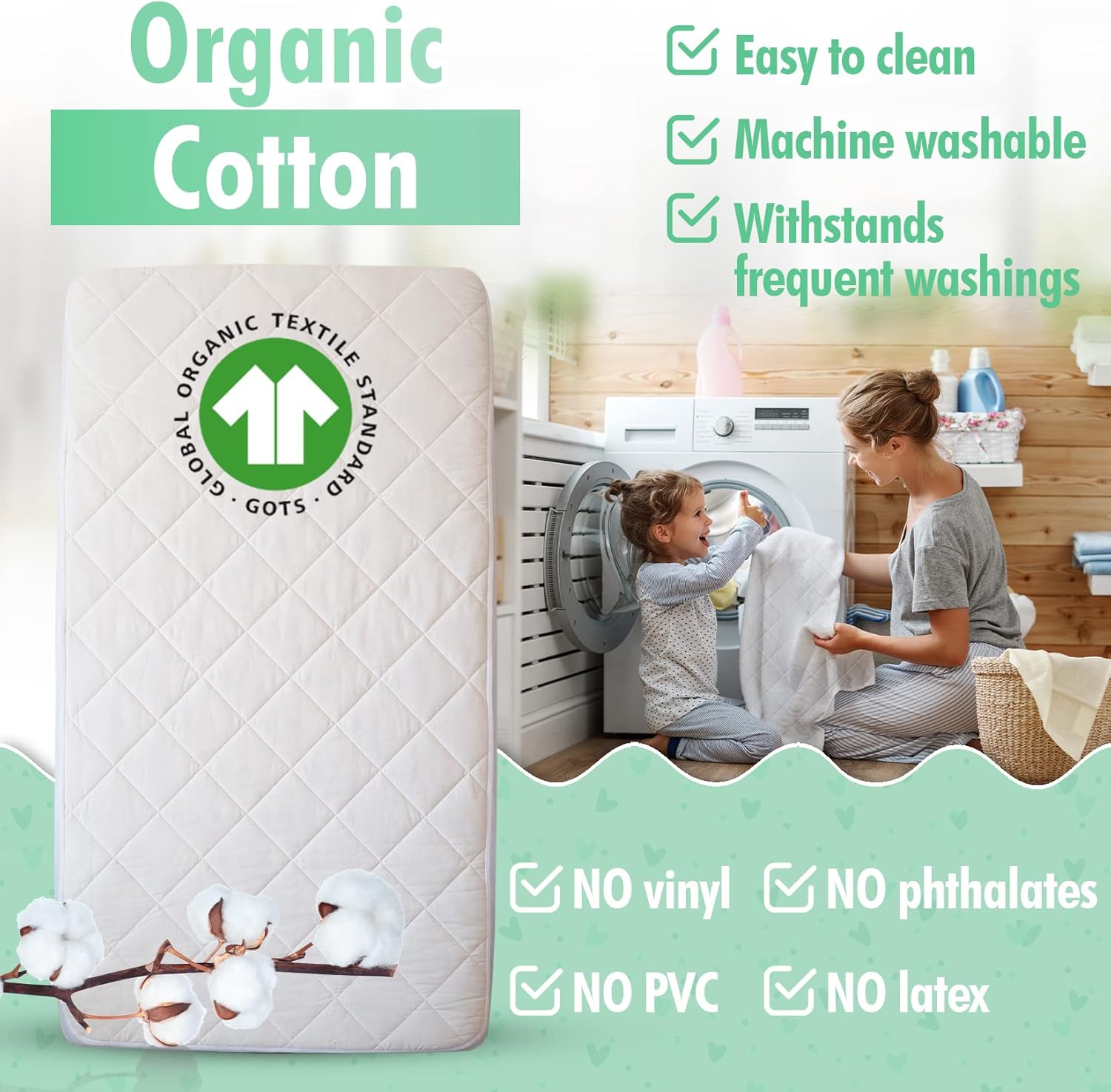
If you’ve started shopping for a crib mattress protector — the waterproof layer that goes over the mattress to guard against leaks and keep the surface clean — you’ve almost certainly seen two acronyms repeated on every “organic” listing: GOTS and OEKO-TEX. They sound like they mean roughly the same thing (“this product is safe and clean”), but they don’t. GOTS (Global Organic Textile Standard) is a certification about how a fabric was grown and manufactured, tracking the cotton or wool from the farm field all the way to the finished product. OEKO-TEX STANDARD 100 is a certification about what’s in the finished fabric, testing the end product for a list of harmful chemical residues. Understanding that single distinction — farm-to-factory versus finished-product chemical testing — is the fastest shortcut to making a confident buying decision. This guide will walk you through what each certification actually guarantees, where the gaps are, how to read a product listing, and what the math looks like at real price points.
What GOTS Actually Certifies (and Where It Stops)
GOTS, governed by the Global Organic Textile Standard organization and currently in Version 7.0 (published 2023), is the most rigorous supply-chain certification available for textiles. To earn the GOTS label, a product must meet three layers of requirements simultaneously.
First: the fiber itself must be certified organic. For cotton — which is the dominant material in crib mattress protectors — that means the fiber must be grown without synthetic pesticides, synthetic fertilizers, or genetically modified seeds, and it must hold a recognized organic agriculture certification (such as USDA NOP in the United States or equivalent programs in India and Turkey, where most organic cotton originates).
Second: every step of processing must meet social and environmental standards. Dyeing facilities, spinning mills, and cut-and-sew factories are all audited. Prohibited substances at the processing stage include chlorine bleaches, formaldehyde-based resins, and a long list of synthetic dyes. Per the GOTS Version 7.0 Standard Document, facilities must also meet minimum social criteria — fair wages, safe working conditions, no child labor — and wastewater from dyeing must be treated before discharge.
Third: the entire chain of custody must be documented and annually re-audited by an independent, GOTS-approved certifier. This is the part that makes GOTS meaningful and expensive: a brand cannot simply claim GOTS on marketing materials. Every party in the supply chain must carry certification, and you can verify any product’s certification status on the GOTS public database by searching the brand or licensee name.
Where GOTS stops: GOTS does not test every individual finished product leaving the factory. It audits processes and inputs. The distinction matters because a certified facility could theoretically have a batch variation. GOTS also does not cover the waterproof layer in most mattress protectors — and this is the critical gap parents often miss.
Most crib mattress protectors use a waterproof backing made from polyurethane (PU) laminate or TPU (thermoplastic polyurethane). These materials are not organic by definition, so they fall outside the organic fiber standard entirely. A protector can carry a GOTS label for its organic cotton quilted top layer while having a waterproof backing that the certification says nothing about. Responsible brands will disclose that the PU/TPU layer is food-grade or meets a separate standard; if a listing is silent on this, it’s worth emailing the brand directly.
What OEKO-TEX STANDARD 100 Certifies (and Where It’s Different)
OEKO-TEX STANDARD 100, maintained by the OEKO-TEX Association (a consortium of independent textile research institutes based primarily in Europe), takes the opposite approach: it starts with the finished article and tests it for harmful substances.
The OEKO-TEX STANDARD 100 test battery covers more than 100 individual substances, including pesticide residues, heavy metals, formaldehyde, pH value, color fastness, and certain flame retardants. The threshold limits are tiered by product class. A product destined for babies under 36 months — Product Class I, the highest-scrutiny tier — must meet the strictest limits across the board. Crucially, OEKO-TEX STANDARD 100 tests the entire finished product, including any waterproof laminate backing, elastic bands, and stitching thread. This is where it fills the gap that GOTS leaves open.
What OEKO-TEX doesn’t certify: OEKO-TEX STANDARD 100 makes no claim about how the fiber was grown. A protector made from conventionally grown cotton — which may have used synthetic pesticides in the field — can earn OEKO-TEX certification if the finished product tests clean of harmful residues. Per the OEKO-TEX Association’s own published overview of the certification, the label communicates “every component of this article has been tested for harmful substances and the article is harmless in terms of human ecology.” It does not communicate anything about farm practices, environmental impact of manufacturing, or fair labor conditions.
The OEKO-TEX ecosystem does include a separate certification called OEKO-TEX MADE IN GREEN, which adds supply-chain traceability and facility-level social standards — making it more comparable to GOTS. If you see MADE IN GREEN (rather than STANDARD 100 alone) on a protector, that’s a broader claim.
Side-by-Side: The Decision Frame
Here’s the comparison distilled to the dimensions that matter most for a crib mattress protector purchase.
| Question | GOTS answers it | OEKO-TEX STANDARD 100 answers it |
|---|---|---|
| Was the cotton grown without synthetic pesticides? | ✅ Yes | ❌ No |
| Is the finished product tested for chemical residues? | Partially (process audit, not batch test) | ✅ Yes, full product |
| Does the waterproof layer fall under the cert? | ❌ Typically not | ✅ Yes (if certified as complete article) |
| Are labor practices audited? | ✅ Yes | ❌ No (unless MADE IN GREEN) |
| Can I verify this online? | ✅ GOTS public database | ✅ OEKO-TEX label check tool |
By the numbers:
- GOTS-certified products must contain a minimum of 95% certified organic fiber content to carry the full GOTS label (a “made with organic” label allows 70%).
- OEKO-TEX STANDARD 100 Product Class I limits formaldehyde to ≤16 mg/kg for baby products — stricter than the Class II (direct skin contact) limit of ≤75 mg/kg.
- The Environmental Working Group’s guide to baby product safety notes that conventional cotton is one of the most pesticide-intensive crops globally, which is why both certifications emerged as meaningful signals rather than marketing noise.
How to Read a Real Product Listing
Armed with the framework above, here’s how to evaluate a listing in practice.
Step 1: Find the certification claim and verify it. A listing that says “GOTS-certified organic cotton” without a licensee number is unverifiable. GOTS publishes a public database where you can search by brand name. OEKO-TEX provides a label check tool where you enter the label number printed on the product tag. If the brand doesn’t provide a certification number, treat the claim as marketing language, not a verified standard.
Step 2: Ask what is certified — the fiber or the finished article. This is especially important for GOTS. If a brand says “made with GOTS-certified organic cotton,” that tells you about the fiber. Ask (or check the listing details) whether the full assembled protector — including the waterproof layer — carries any certification. Wirecutter’s review of crib mattress protectors consistently highlights that the waterproof backing is the component most likely to be skipped in organic certifications, and recommends buyers look for explicit disclosure of the laminate material.
Step 3: Match the certification to your actual priority. If your primary concern is farm-level pesticide reduction and supply-chain ethics, GOTS is the signal you want. If your primary concern is “will the finished product that my infant drools on and chews test clean of harmful residues,” OEKO-TEX STANDARD 100 Product Class I is the direct answer. The ideal scenario — and a real one that several premium brands achieve — is a protector carrying both certifications. That combination means the cotton was grown organically and the finished product tested clean across the full article.
Step 4: Don’t let the certification override fit. Healthychildren.org (American Academy of Pediatrics) is clear that a crib mattress protector must fit snugly without bunching — a loose protector creates a suffocation hazard regardless of its certification status. The safest certified protector is one that fits your specific mattress dimensions and stays flat under normal use. The U.S. Consumer Product Safety Commission (CPSC) guidance on nursery products reinforces that mattress accessories must be sized for the mattress they’re used with.
Price Point Reality Check
At the May 2026 market, GOTS-certified organic cotton crib mattress protectors typically run $45–$90 for a standard crib size (52” × 28”). Protectors carrying OEKO-TEX STANDARD 100 Product Class I (without GOTS) often start lower, in the $25–$55 range, because the fiber sourcing is less constrained. Products carrying both certifications tend to cluster at $65–$110+, with boutique and Certified B Corporation brands at the top of that range.
The cost-per-month math is straightforward: most parents use a crib mattress protector from birth through 18–24 months of active crib sleeping, and most buy two (for laundry rotation). A $75 protector used for 20 months costs about $3.75/month. A $30 protector that pills, delaminates, or leaks through its waterproof layer after six months of washing costs more in replacement and frustration than the premium alternative.
The Decision Rule
If your priority is supply-chain integrity and organic farming — you want to know the cotton was grown cleanly before it became a fabric — look for GOTS certification and verify the licensee number in the GOTS public database.
If your priority is finished-product chemical safety — you want proof that the actual item touching your infant tested clean — look for OEKO-TEX STANDARD 100, Product Class I and verify the label number through the OEKO-TEX label check tool.
If you want both guarantees, which is a reasonable position for a product that will be in close contact with a chewing, drooling infant for two years, look for a protector that lists both certifications, confirm each one is verifiable, and confirm the waterproof layer is explicitly covered or disclosed. That’s not a unicorn product — several established nursery brands offer exactly this combination — but it requires reading past the marketing headline to the certification details.
The label is only as good as the database entry behind it. Verify, then buy with confidence.