May 21, 2026 • Yuki Brennan • 9 min reading time • Prices verified June 18, 2026
Patterned Mesh Crib Liners That Actually Match Your Nursery Theme
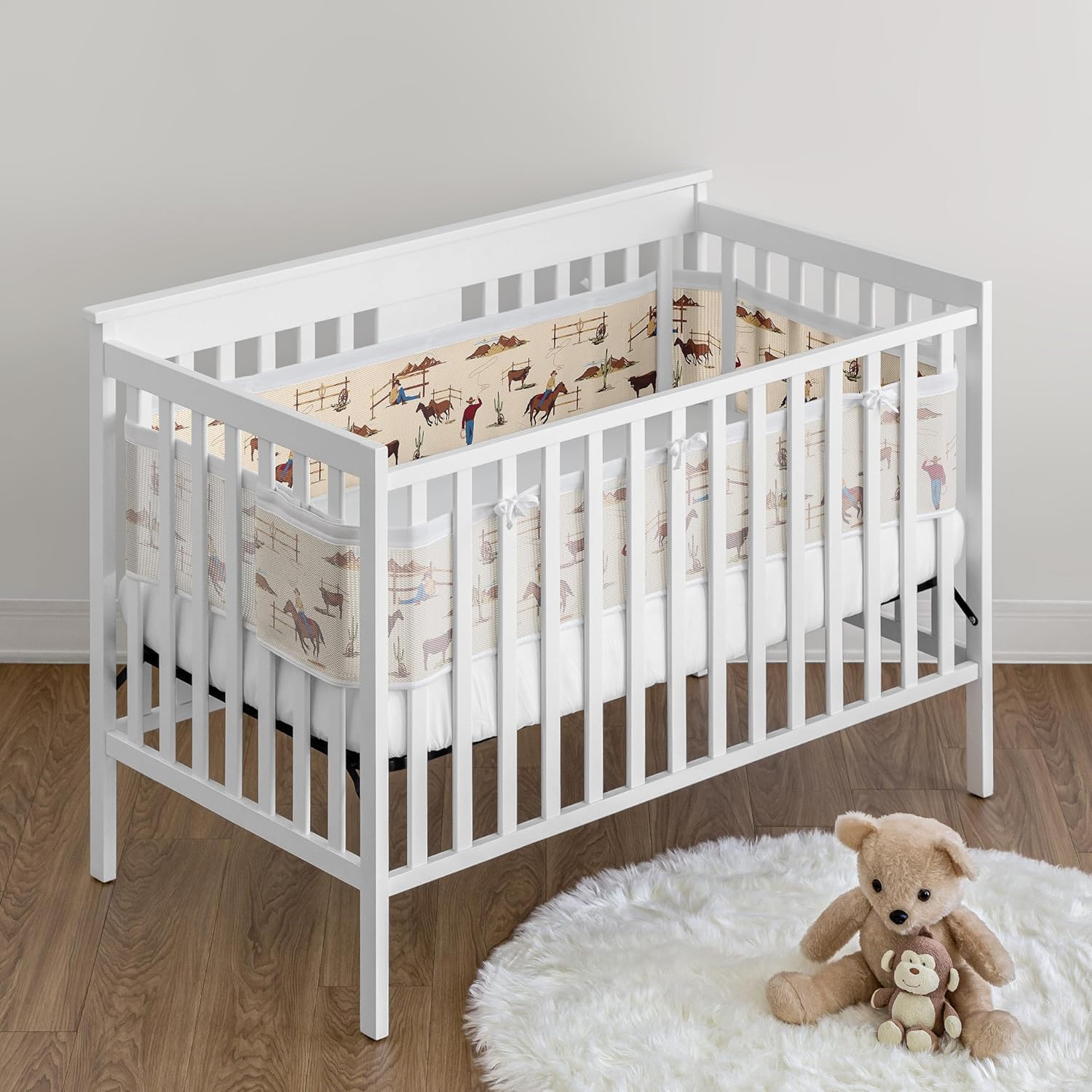
If you’ve started shopping for a crib liner — the padded or mesh strip that wraps around the inside of a crib’s rails — you’ve probably already encountered the safety debate. Traditional padded bumpers have been widely flagged as a suffocation risk for infants who can’t yet roll away from soft surfaces, and as of 2022 they are banned from sale in the United States under the Safe Sleep for Babies Act. What’s replaced them in the market are breathable mesh liners: thin, open-weave fabric guards that protect wooden rails from chewing damage while still letting air pass freely through the weave, so a baby’s face pressed against the liner doesn’t create a sealed pocket of re-breathed air. The American Academy of Pediatrics’ Safe Sleep guidelines, hosted on healthychildren.org, stop short of endorsing any bumper product but acknowledge that mesh liners are structurally different from the thick padded bumpers the research flagged.
So: the safety case for mesh is sound, the products are legal, and now the real question is whether you can find one that doesn’t look like an afterthought in a carefully styled nursery. The short answer is yes — if you know which brands are actually investing in pattern design versus which ones are just printing a stock floral on whatever fabric is cheapest. This guide breaks that down.
Why Pattern Design in Mesh Liners Is Harder Than It Looks
Mesh by definition has a limited “canvas.” The open weave that makes a liner breathable also limits how much print detail survives the manufacturing process. A fine watercolor print that looks beautiful in a product photo can wash out to a muddy blur on actual mesh fabric. This is the core tradeoff brand-conscious parents run into when they try to match, say, a Rifle Paper Co. wallpaper moment or a Scandinavian neutral palette.
There are two families of patterned mesh on the market right now:
Printed mesh applies dye or pigment directly to the woven surface. The pattern is visible but inherits the texture of the mesh — think of it like printing on a window screen. Colors read well from a distance; fine-line details soften up close. This is most common in the $25–$55 price range.
Panel-and-trim construction stitches patterned fabric panels — usually a woven cotton or muslin — to a mesh backing or uses fabric trim as the visible face of the liner. The mesh is structural; the pattern fabric is the aesthetic layer. This approach reproduces pattern fidelity much closer to flat fabric, and it’s where brands like Sweet Jojo Designs operate. It’s also where you’ll find genuine OEKO-TEX Standard 100 certification meaningful, because the certifying body (the OEKO-TEX Association, per their published STANDARD 100 explainer) tests every component of a finished product — mesh, fabric panel, thread, and dye — for harmful substances. A liner with panel-and-trim construction has more certifiable components, which is actually a good thing: it means the certification is doing more work.
The Two Brands Worth Knowing: Sweet Jojo Designs vs. BreathableBaby
These two names come up most often in patterned-liner searches, and they occupy meaningfully different positions.
BreathableBaby is the category pioneer — the brand that essentially created the mesh liner market in the early 2000s and remains the default recommendation on aggregator sites. BabyGearLab’s crib bumper and liner reviews consistently place BreathableBaby in their top tier for breathability and universal crib fit. The mesh is a proprietary open-weave construction, and the liner wraps the full interior perimeter of a standard crib. Where BreathableBaby has historically underinvested is pattern depth: their print library runs toward simple repeating geometrics and a small selection of botanicals. If your nursery is built around a tight color story — dusty sage, terracotta, warm ivory — you will likely find BreathableBaby’s colorways too primary, too generic, or simply unavailable in your palette. Reviewers across parenting forums (cited in the aggregate, not linked) consistently praise the product’s function and flag its design limitations in the same breath.
Sweet Jojo Designs approaches the market from the opposite direction. They started as a crib bedding set company — full nursery collections with coordinating sheets, skirts, mobiles, and wall art — and the crib liner is a designed component of a larger room story. Their liners use the panel-and-trim construction described above, meaning the visible face is typically a cotton-blend fabric in the pattern of your chosen collection. Pattern libraries as of mid-2026 include: boho macramé-inspired neutrals, vintage floral in muted rose and sage, woodland animal prints, rainbow-stripe in both bold and pastel weights, and several gender-neutral geometric options. If you’re building a room around a theme — not just buying a single product — Sweet Jojo’s ecosystem approach means your liner, crib sheet, and window valance can share a fabric story without custom sourcing.
The tradeoff: Sweet Jojo liners are pattern-first, and their mesh backing prioritizes aesthetics over the ultra-open breathability of BreathableBaby’s dedicated breathable weave. Parents with strong concerns about airflow should weigh this carefully.
By the Numbers
| Brand | Approx. Price (2026) | Cert. Available | Pattern Depth | Breathability Priority |
|---|---|---|---|---|
| BreathableBaby (solid/basic print) | $28–$42 | Limited OEKO-TEX coverage | Low–Medium | Primary design goal |
| Sweet Jojo Designs (collection liner) | $38–$65 | OEKO-TEX Standard 100 on select lines | High | Secondary to aesthetics |
| Loulou Lollipop (silicone rail guard) | $80–$150+ | Food-grade silicone, no textile cert | None (solid) | N/A — not mesh |
Matching a Liner to Your Nursery Theme: A Decision Framework
Here’s where the practitioner question kicks in: you have a nursery palette in mind, possibly a crib model in hand, and you need to make a choice. Work through these three filters in order.
Filter 1: What Is Your Actual Safety Priority?
If your baby is under four months, not yet rolling, and you’re using the liner primarily to protect the rails from future chewing, airflow is your dominant variable. The Consumer Product Safety Commission’s crib safety publication emphasizes that any item added to a crib sleep environment should not obstruct air circulation near the infant’s face. In that window, BreathableBaby’s open weave earns its reputation.
If your baby is actively pulling to stand, chewing the rails daily, and you’re protecting wood finish and your own hands from splinters, you’ve shifted contexts. At that developmental stage, the risk profile of a well-fitted mesh liner is different, and pattern aesthetics become a more legitimate factor in the decision.
Filter 2: What Does Your Crib Actually Accommodate?
Slat spacing and rail height vary by manufacturer, and a liner that bunches, gaps, or ties awkwardly will look worse than no liner at all. BreathableBaby publishes a fit guide by crib model on their product pages — worth checking before ordering. Sweet Jojo’s liners are sized for standard full-size cribs (interior dimension roughly 28” × 52”) and list compatibility notes for their popular collections. Convertible cribs with non-standard rail profiles (certain IKEA Sundvik configurations, for example, or cribs with extra-tall rails) may require measuring before buying either brand.
Filter 3: Are You Matching a Theme or Anchoring a Palette?
This is the design question, and it’s the one most parents underestimate. There are two different jobs a patterned liner can do:
Theme matching means your nursery has a defined motif — forest animals, celestial stars, vintage botanical — and the liner participates in that narrative. Sweet Jojo Designs is built for this use case. Their collection pages show the liner in situ with coordinating pieces, so you can see how the pattern reads at crib distance in a styled room, not just as a flat product photo.
Palette anchoring means your nursery is color-driven — a specific terracotta, a dusty blue-green, an off-white linen story — and you need the liner to recede or complement without introducing competing motifs. In this case, a solid-color mesh or a very low-contrast print often serves better than a busy pattern. BreathableBaby’s solid white and solid grey options fit here, as does the increasingly available category of undyed organic muslin rail covers from smaller makers.
Certification: What to Actually Check Before You Buy
OEKO-TEX Standard 100 certification (issued by the OEKO-TEX Association, an independent testing body based in Europe) means every component of the finished product has been tested against a list of harmful substances — including formaldehyde, heavy metals in dyes, and pH levels that could irritate infant skin. For a chewing baby, this is the certification that matters most, because the substance contact isn’t incidental — a teething infant is actively mouthing the fabric repeatedly.
GOTS (Global Organic Textile Standard) goes further, certifying the entire supply chain from fiber to finished product as organic, but it’s less commonly found on mesh liners specifically because the mesh weave itself is rarely organic cotton. If GOTS is your non-negotiable, you’re more likely to find it on flat rail cover sleeves than on full mesh liners.
What to look for when browsing product pages: the OEKO-TEX certification should include a certification number you can verify on the OEKO-TEX Association’s website (oeko-tex.com). A logo without a number is unverifiable and worth treating as decoration rather than assurance.
The Decision Rule
If you’re still deciding after running those filters, here’s the clean version:
- If airflow is your primary concern and design is secondary → BreathableBaby, solid or simple print, verified breathable weave. Stop shopping.
- If you’re building a themed nursery and your baby is past the newborn stage → Sweet Jojo Designs, matched to your collection, with OEKO-TEX number verified before purchase.
- If your nursery is palette-driven rather than theme-driven → Look at solid organic muslin rail cover sleeves from smaller makers before committing to either brand. A liner that reads as texture rather than pattern often photographs better in a design-led room anyway.
- If you’re buying as a gift → Sweet Jojo’s collection approach wins for presentation and room coherence. Confirm the recipient’s crib model and current nursery collection before selecting a pattern.
The liner you’ll be happiest with isn’t the one with the highest rating on a comparison site — it’s the one that does the right job for where your baby actually is developmentally, fits the crib you actually own, and holds up to washing without the pattern degrading to grey mush by month three. Reviewers who’ve owned Sweet Jojo liners long-term note that the panel construction holds pattern integrity through repeated washing better than printed mesh alternatives. BreathableBaby owners report the opposite tradeoff: the mesh itself outlasts most crib setups, but any printed pattern fades faster than the structural mesh does.
Pick the tradeoff you can live with, verify the certification number, measure your crib, and order with confidence.